Research
I work in continuous optimization and variational analysis. Many problems in data science, imaging, and engineering lead to optimization models with kinks, corners, or constraints, where classical derivatives break down. My research uses generalized differentiation to answer two practical questions about such problems: how to solve them fast, and when their solutions can be trusted.
Fast Newton-type methods for nonsmooth optimization
Many models in statistics, signal processing, and machine learning have the form \(\min_x f(x) + g(x)\): a smooth data-fitting term \(f\) plus a nonsmooth regularizer \(g\) that encodes structure, such as sparsity (Lasso), grouped variables (Group Lasso), or piecewise-constant signals (total variation). First-order methods such as proximal gradient (ISTA/FISTA) are simple and cheap per step, but they become very slow when high accuracy is needed. Newton’s method converges much faster, but it needs second derivatives, which the regularizer \(g\) does not have.
Our approach is built on effective subspaces. Near a solution, a polyhedral regularizer is linear along certain directions. A cheap proximal step identifies this subspace, and a Newton step restricted to it needs only the Hessian of \(f\) and first-order information about \(g\). We prove local quadratic convergence under tilt stability, without the strict complementarity (nondegeneracy) assumptions common in earlier work, and we give explicit formulas for the \(\ell_1\), \(\ell_\infty\), OSCAR/SLOPE, and total-variation regularizers. Current work extends the idea to generalized equations and to the non-polyhedral Group Lasso, and develops Newton methods that converge globally while working with the nonsmooth problem directly rather than with a smooth surrogate of it.
Papers
-
Nonsmooth Newton methods with effective subspaces for polyhedral regularization
Mathematics of Operations Research, to appear (accepted September 2026)
-
A globally convergent Newton method for nonsmooth optimization in the absence of smooth surrogates
Submitted to Journal of Scientific Computing (2026)
With Tran T. A. Nghia, Khoa V. H. Vu, and Samik Barman.
Stability of regularized inverse problems
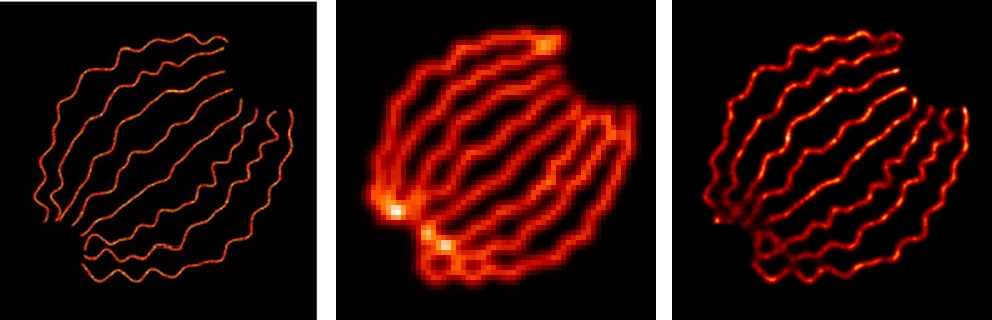
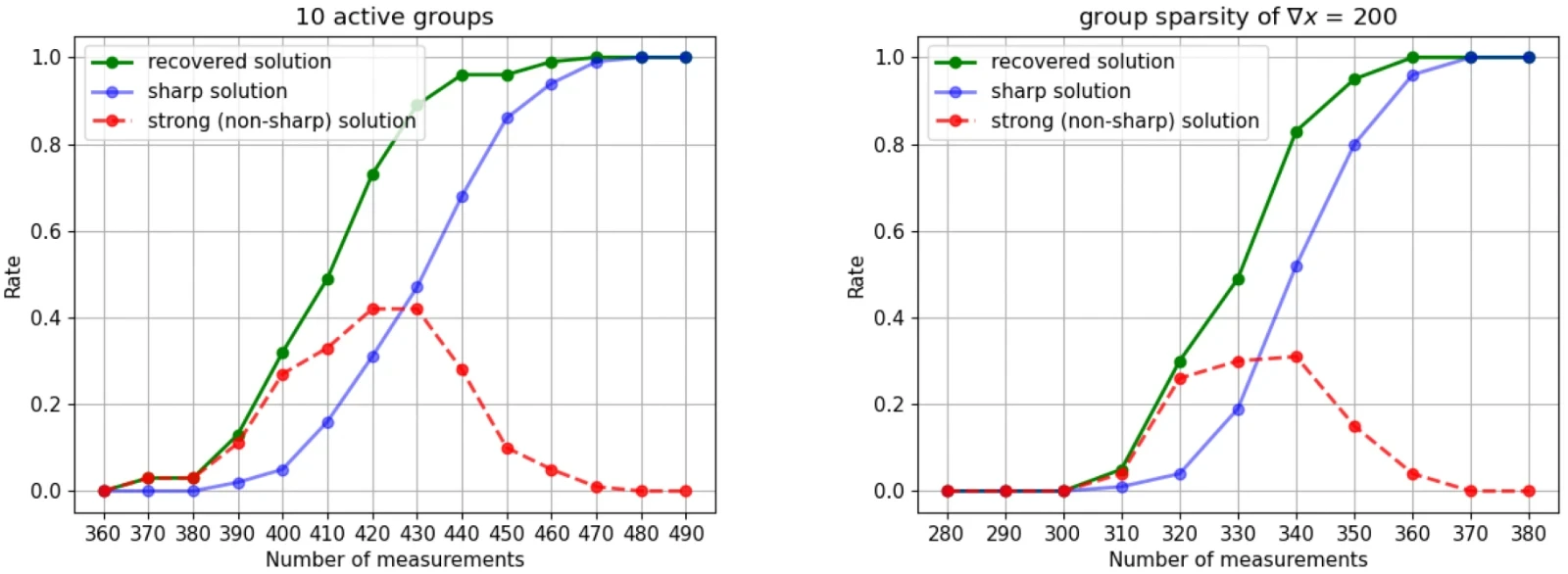
In an inverse problem we want an unknown signal or image \(x_0\), but we only see indirect, noisy measurements \(y \approx \Phi x_0\). Examples include MRI, deblurring, and compressed sensing, where there are far fewer measurements than unknowns. Regularizing with a convex penalty such as the \(\ell_1\) norm, the group \(\ell_1/\ell_2\) norm, or total variation selects a structured solution. The question I study is reliability. If the noise has size \(\delta\), is the computed solution within \(O(\delta)\) of the truth? This property is called stable recovery. A closely related property, isolated calmness, asks that the solution move at most linearly when the data move.
Classical sufficient conditions rely on sharp minima and on first-order information about the regularizer. We showed that the exact condition is second-order: stable recovery holds if and only if the kernel of \(\Phi\) meets a certain tangent cone, built from the subdifferential of the regularizer, only at zero. For piecewise linear-quadratic regularizers, such as \(\ell_1\), total variation, and the elastic net, this reduces to something familiar: stable recovery is equivalent to the true signal being the unique solution. The same tangent-cone condition characterizes isolated calmness. For analysis-sparsity models it can be checked by solving linear programs. We also give a group-sparsity example where the solution is unique but not calm, so non-polyhedral regularizers genuinely need the second-order theory. Ongoing work studies full Lipschitz stability of the solution map.
Papers
-
Stable recovery of regularized linear inverse problems
Inverse Problems 41(6), 065018 (2025)
-
Isolated calmness of regularized linear inverse problems
Submitted to Optimization (2026)
With Tran T. A. Nghia, Huy N. Pham, and Khoa V. H. Vu.
Nonconvex optimization in PDE control and machine learning
Two applied projects take these tools to settings where convexity is lost.
PDE-constrained optimization
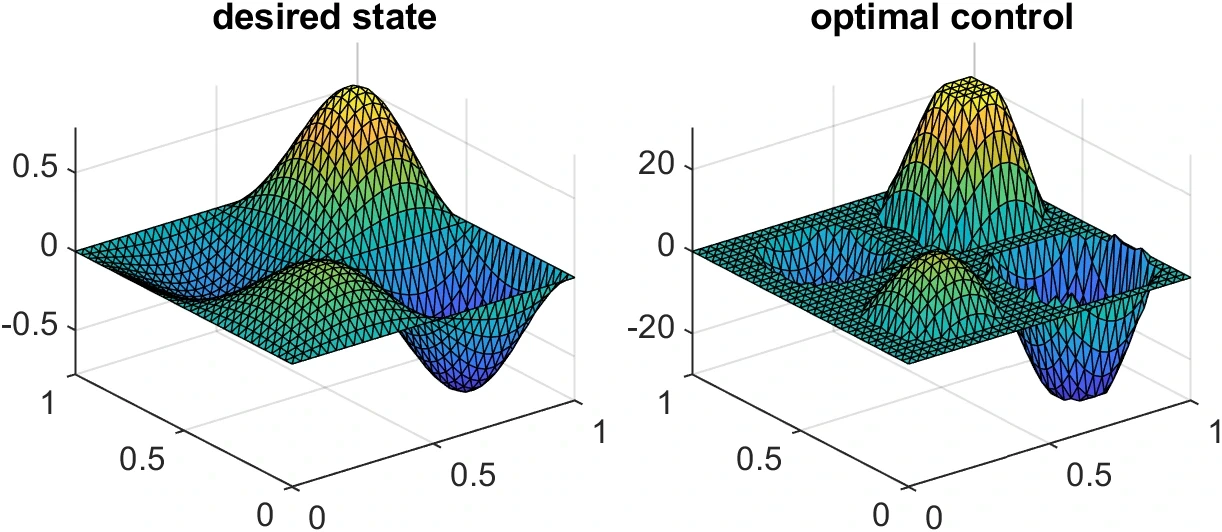
In optimal control we choose a control, for example a heat source spread over a plate, so that the resulting state, governed by a partial differential equation, is close to a target. Sparse controls that act only on small regions are often preferable. The nonconvex \(L^1-L^2\) penalty promotes sparsity more strongly than \(L^1\) alone, and it gives the problem a difference-of-convex (DC) structure. We designed I-ADCA, an inexact and accelerated DC algorithm in Hilbert spaces. Each step may use an inexact subgradient and solve its convex PDE subproblem only approximately, as happens in practice, yet the method still converges to stationary points, with explicit rates under a Polyak–Łojasiewicz-type condition. Combined with finite elements, it comes with error bounds for the discretized problem. On the finest mesh in the paper (16,129 unknowns), it needed about half the CPU time of the classical DC algorithm.
Knowledge distillation
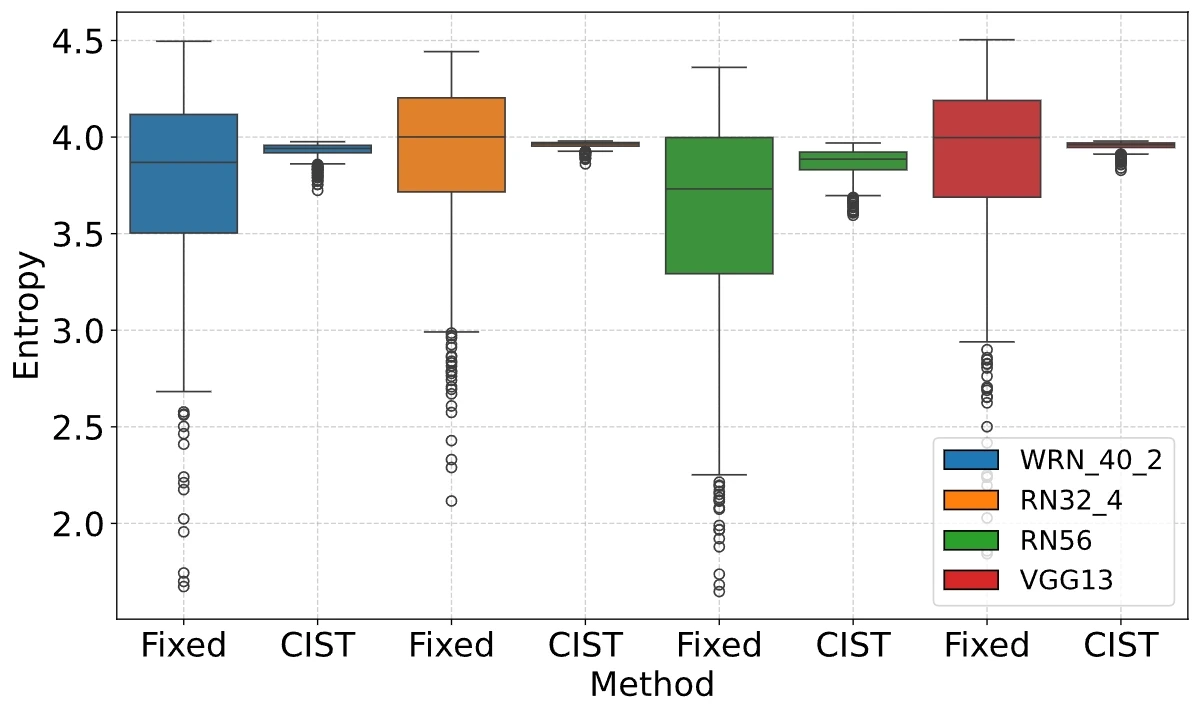
Large neural networks are accurate but expensive to deploy. Knowledge distillation trains a small student network to imitate the softened predictions, or soft labels, of a large teacher. The softening is controlled by a temperature, traditionally one fixed number for all data. We showed that the information content (entropy) of a soft label is governed mainly by the ratio between the teacher’s largest logit and the temperature. With one fixed temperature, some soft labels are therefore nearly one-hot and others nearly uniform. Our method, CIST, picks the temperature for each sample, separately for teacher and student, so that every soft label is similarly informative. It improves standard distillation and strong baselines on CIFAR-100, ImageNet, and language-model distillation, at negligible extra cost. For example, a ResNet8×4 student distilled from a ResNet32×4 teacher on CIFAR-100 goes from 73.33% to 76.96% top-1 accuracy.
Papers
-
Inexact DC algorithms in Hilbert spaces with applications to PDE-constrained optimization
Submitted to Applied Mathematics & Optimization (2026)
-
Consistently informative soft-label temperature for knowledge distillation
Submitted to the International Conference on Artificial Intelligence and Statistics (AISTATS 2027)
With P. D. Khanh, V. V. H. Khoa, B. S. Mordukhovich, and D. B. Tran (DC algorithms), and with Hoang-Chau Luong, Kaiqi Zhao, and Lingwei Chen (knowledge distillation).
Earlier work: regularity theory for p-Laplace equations
Before moving to optimization, during my undergraduate studies in Ho Chi Minh City, I worked on the regularity of solutions to quasilinear elliptic equations of p-Laplace type. These equations model nonlinear diffusion and non-Newtonian flow. The basic question: if the data of the equation are controlled in some function space, how well behaved is the gradient of the solution? We proved gradient estimates expressed through fractional maximal operators, in Morrey spaces and in weighted Lorentz spaces.
Papers
-
A regularity result via fractional maximal operators for p-Laplace equations in weighted Lorentz spaces
Complex Variables and Elliptic Equations 67(7), 1737–1755 (2022)
-
A gradient estimate related fractional maximal operators for a p-Laplace problem in Morrey spaces
Taiwanese Journal of Mathematics 25(4), 809–829 (2021)
With Cao-Kha Doan, Gia-Bao Nguyen, Thanh-Nhan Nguyen, and Minh-Phuong Tran.