Newton-type methods for nonsmooth optimization
A short, illustrated introduction to my main research direction: how to get Newton's fast convergence on problems whose regularizer has corners.
Smooth data fit plus a nonsmooth regularizer
A large class of models in statistics, imaging, and machine learning asks us to solve
\[\min_{x}\; f(x) + g(x),\]where \(f\) is a smooth loss that fits the data (least squares, logistic loss, a Poisson likelihood) and \(g\) is a regularizer that enforces structure in the solution. Many of the most useful regularizers are polyhedral: their level sets are polytopes with flat faces, corners, and edges. Sparse solutions sit exactly at those corners, which is why such regularizers produce sparse or piecewise-constant answers.
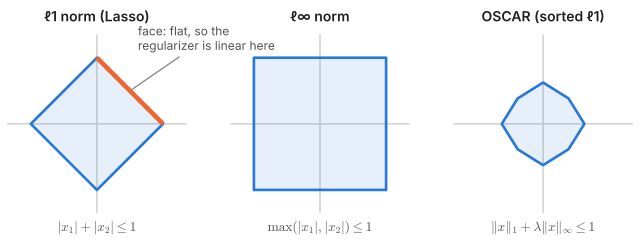
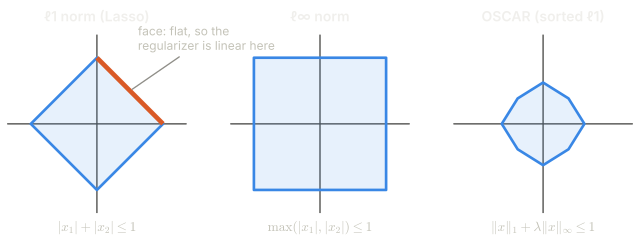
The difficulty is that \(g\) has no second derivative at exactly the points we care about. First-order methods such as ISTA and FISTA only need the proximal map of \(g\), but they converge slowly once high accuracy is required. Newton’s method is fast, but it needs curvature that \(g\) does not have.
Find the flat directions, then take a Newton step there
On a face of a polyhedral regularizer, \(g\) is linear, so it adds no curvature at all. If we knew which face the solution lies on, we could restrict the problem to that face, where only the smooth part \(f\) is curved, and take an ordinary Newton step. The directions along that face form what we call the effective subspace. Our methods find it from information that first-order methods already compute: one proximal-gradient step produces a point \(y\) and a subgradient \(z\) of \(g\) at \(y\), and the effective subspace is read off from \(z\), as the parallel space of \(\partial g^*(z)\). Then a Newton step is taken inside that subspace.
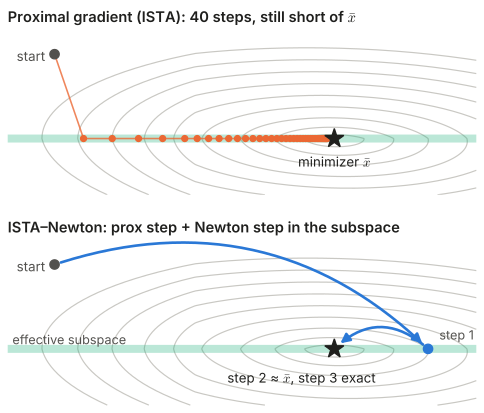
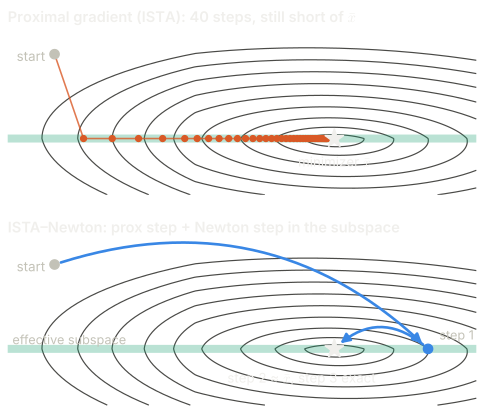
For the ℓ1 norm the recipe is very concrete: the effective subspace consists of the coordinates where the subgradient \(z_i\) equals \(\pm\lambda\), and the Newton step solves a small linear system on those coordinates only. We derive similarly explicit formulas for the ℓ∞ norm, the sorted ℓ1 norm (OSCAR/SLOPE), and one-dimensional total variation.
What we prove
- Fast. If the minimizer is tilt-stable, a standard second-order stability property, the ISTA–Newton method converges quadratically from nearby starting points: the number of correct digits roughly doubles at each step.
- Weak assumptions. No strict complementarity or nondegeneracy condition is needed. The paper gives an example where that condition fails and quadratic convergence still holds.
- Cheap. Only the proximal map of \(g\) and the Hessian of \(f\) on a subspace are used. No generalized Hessian of the regularizer is needed.
- Practical. An accelerated variant (FISTA–Newton) and line-search versions work well in practice. Away from the solution, each iteration costs about as much as a first-order step.
What it looks like on real problems
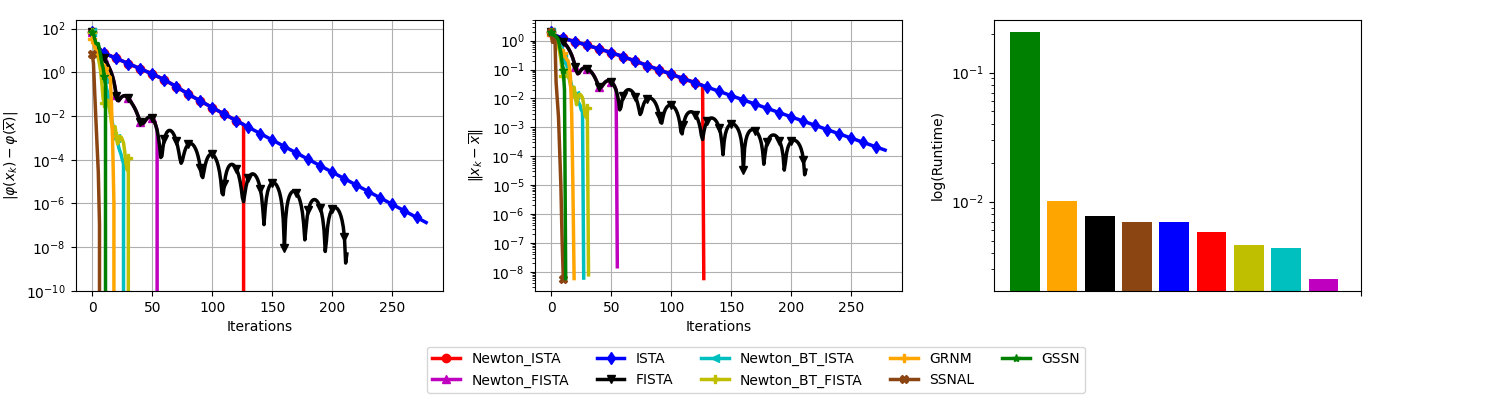
The paper reports the same behavior for the ℓ∞ norm, OSCAR, and total-variation problems, and for super-resolution microscopy with Poisson noise, shown on the Research page.
Where this direction is going
-
Nonsmooth Newton methods with effective subspaces for polyhedral regularization
Mathematics of Operations Research, to appear (accepted September 2026)
-
A globally convergent Newton method for nonsmooth optimization in the absence of smooth surrogates
Submitted to Journal of Scientific Computing (2026)